Click On Picture for Larger Image
Scorpions
Author: Ray Bowers
Click On Picture for Larger Image |
Species: Vaejovis vittatuss |
Description:
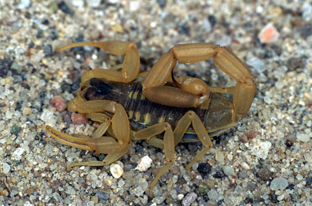
Scorpions are the oldest known terrestrial arthropods, with some fossils being 400 million years old. Some of the fossil scorpions were from 44 to 86cm long. The pedipalps of scorpions are enlarged to form a pair of pincers. Scorpions have an elongate abdomen that ends in a sting apparatus. The yellow brown body is 4 to 8 cm (1.5 to 3 inches) long with dark stripes on the abdomen. There are a number of species in the genus Vaejovis that are Very similar and often require capture and measurement to distinguish absolutely.
Geographic range:
Scorpions have been found as far north as Virginia and British Columbia, Canada, but they are most abundant in the Gulf States and the Southwest. This species is found throughout New Mexico.
Habitat:
Vaejovis is found in a variety of terrestrial habitats from arroyos to open desert in rock piles or dead plant material. They seek the most humid areas they can find within any habitat. Which leads them into newly constructed buildings, which have drying plaster and concrete.
Food Web:
Scorpions will feed on any arthropod they can capture especially insects. They in turn will be eaten by a variety of arthropods and vertebrates.
Reproduction and Development:
Because of the predatory nature of scorpions, an extensive courtship ritual has evolved so that the female will not consider the male prey. After fertilization development may take several within the female before the young are born. The young crawl onto the mother's back, where they remain until the first molt.
Behavior:
Scorpions spend most of the day in burrows, avoiding the high temperatures and low humidity during the middle of the day. They are secretive nocturnal predators that usually sit and wait for the prey organism to come along. Vibrations through hairs on the legs detect the prey. Upon being identified, the prey will be held by the pincers and stung. The reaction to most scorpion venom is similar to a bee or wasp sting, although some can be toxic to sensitive adults or children.
Ecosystem roles:
Scorpions feed on arthropods, especially insects and play an important role in controlling insect populations.
Other info:
Scorpions glow with a yellow-green color when an ultra-violet light shines on them and this is one way of finding them at night.
Taxonomy:
Kingdom: Animalia
Phylum: Arthropoda
Subphylum: Chelicerata
Class: Arachnida
Order: Scorpiones
Family: Buthidae
Genus: Vaejovis
Species: Vaejovis vittatuss
References:
Borror, Donald J. and Richard E. White. 1970. A Field Guide to the Insects of America North of Mexico. Boston : Houghton Mifflin Co.
Barnes, Robert D. 1980. Invertebrate Zoology. Philadelphia : W. B. Saunders Co.
Borror, Donald J., Charles A. Triplehorn, and Norman F. Johnson. 1989. An Introduction to the Study of Insects. Philadelphia: W. B. Saunders Co.
Levi, Herbert W. and Lorna R. Levi. 1987. Spiders and Their Kin. Racine, Wisconsin : Golden Press
New Mexico Game & Fish. 2000. Devil Scorpion Vaejovis spinigeris. Biota Information System of New Mexico. www.fw.vt.edu/fishex/nmex_main/species/320030.htm
Werner, Floyd and Carl Olson. 1994. Insects of the Southwest. Fisher Books,LLC.
Related Terms: Arthropoda, Aracnida